Sony FX5 Full Review: Specifications, Features, and Comparison with the FX3, FX6 and Canon C50
Sony officially unveiled the FX5 on 22 July 2026. This new full-frame cinema camera slots between the compact FX3 and the professional FX6, bringing technologies that were, until recently, reserved for much pricier systems. In this review we dive deep into the specifications, break down what each feature means on set, and place the FX5 side by side with the leading competitors in today's cinema camera landscape.
The new Sony FX5 in a nutshell
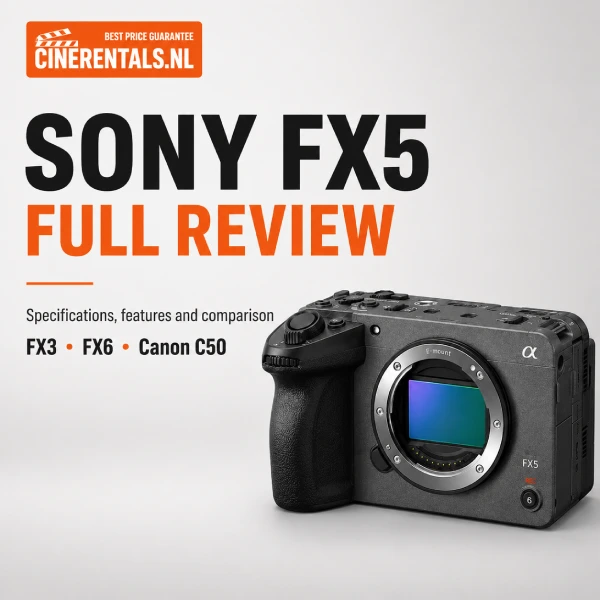
The FX5 is the first Sony Cinema Line camera to combine 5K Open Gate recording with internal 16-bit X-OCN RAW. Sony developed an entirely new stacked CMOS sensor specifically for this model, driven by the latest BIONZ XR2 processor. The body weighs just 750 grams, making the FX5 one of the lightest full-frame cinema cameras on the market.
Cinematographer Claudio Miranda, known for Life of Pi and Top Gun: Maverick, tested the camera in advance and described it as a combination of high image quality and mobility in a compact form factor. Director Gareth Edwards called it the run-and-gun cinema camera to beat. Strong words, but the specs back them up.
Price and availability at a glance
At retail the Sony FX5 body sits at around 5,600 euro, with the XLR handle version reaching close to six thousand euro. Official delivery starts in the second half of August 2026. If you would rather test the camera on your own project before committing to a purchase, you can rent the FX5 at CineRentals in Amsterdam from 85 euro per day or 270 euro per week, including insurance, cleaning and technical support. That means you can put every feature covered below through a real shoot for a fraction of the purchase cost.
Rent now; https://cinerentals.nl/en/equipment/sony-fx5-cinema-camera
Complete technical specifications
Sensor and image processing
- 16.6 megapixel full-frame back-illuminated stacked CMOS
- BIONZ XR2 processor with dedicated AI unit
- More than 15 stops of dynamic range in S-Log3
- 14+ stops of dynamic range for HDR workflows
- Global shutter readout minimises rolling shutter artefacts
Recording capabilities
- 5K Open Gate (3:2) up to 60 fps at launch, 120 fps via firmware in 2027
- 4K DCI and UHD up to 120 fps
- Full HD up to 240 fps for razor-sharp slow motion
- Internal 16-bit X-OCN ST, C1 and C2
- XAVC S, XAVC HS and XAVC S-I codecs
- S-Cinetone, S-Log3, S-Gamut3 and HLG picture profiles
ISO and light sensitivity
- Triple base ISO: 800, 4000 and 12800
- Dual Gain readout for improved shadow detail
- ISO range from 80 to 409,600 (extended)
Autofocus and tracking
- AI-driven pose estimation recognises eyes, head and body
- 759 phase detection AF points covering 94% of the frame
- Real-time Eye AF for humans, animals and birds
- Reliable performance down to -6 EV in low light
Stabilisation
- 5-axis in-body image stabilisation
- Roll correction doubled compared to the FX3
- Active and Dynamic modes for handheld work
Audio
- Built-in stereo microphone
- Optional XLR-H2 handle with two XLR and TRS inputs
- 32-bit float audio at 96 kHz sampling
Connectivity and storage
- Two USB Type-C ports with Power Delivery and timecode
- Wired LAN port for remote production
- Multi Interface Shoe for accessories
- Dual card slots: CFexpress Type A and SD UHS-II
- Full-size HDMI and 3.5 mm headphone jack
Body and battery
- Weight: 750 grams (body only)
- Dimensions: 132.3 x 79 x 86.95 mm
- Weather-sealed magnesium alloy chassis
- NP-FZ100 battery, roughly 170 minutes of continuous 5K recording
- Built-in fan for unlimited recording time
Comparison: FX5 versus FX3
The FX3 remains an excellent cinema camera for smaller productions and run-and-gun work. The FX5, however, raises nearly every aspect to a higher level. If you are weighing these two models, here is what actually sets them apart.
Sensor and resolution
The FX3 uses the 12.1 MP sensor derived from the A7S III. The FX5 introduces a brand-new 16.6 MP stacked sensor, unlocking 5K Open Gate recording against the FX3's 4K UHD ceiling. For production houses that need to deliver both vertical social media and horizontal cinema formats from a single take, Open Gate is a major workflow advantage.
RAW recording
The FX3 only offers external 16-bit RAW via HDMI, which requires an Atomos Ninja or similar recorder. The FX5 writes internal 16-bit X-OCN RAW directly to a CFexpress card. That saves you around a thousand euro on an external recorder and simplifies the on-location workflow considerably.
ISO performance
The FX3 works with a dual base ISO (640 and 12800). The FX5 adds a third base ISO (800, 4000 and 12800), giving you a clean, noise-free starting point in more lighting situations. For documentary shooters who move between bright daylight and dim interiors throughout the day, this is a meaningful improvement.
Frame rates
The FX3 hits 4K at 120 fps and Full HD at 240 fps. The FX5 matches those numbers and adds 5K at 60 fps (later 120 fps). Slow motion enthusiasts get more creative headroom on the FX5, particularly at resolutions that hold up on cinema projection.
At purchase the FX3 still lands around 4,500 euro, while the FX5 sits at roughly 5,600 euro. That extra thousand euro buys you a substantially improved sensor, internal RAW recording and a third base ISO. Have a look at the Sony FX3 product page at CineRentals if you are torn between renting or comparing head to head.
Comparison: FX5 versus FX6
The FX6 has been the standard for professional documentary and broadcast productions for several years now. The question is: does the FX5 replace the FX6?
Form factor and workflow
The FX6 features ergonomics designed for traditional cinema work: shoulder-mounted operation, follow focus, external lighting rigs. The FX5 follows the more compact FX3 line and fits better on gimbals and in tight spaces. For production houses that want to combine both approaches, the FX5 is a logical addition to an existing FX6 workflow.
Sensor and image quality
The FX6 uses the same 12.1 MP sensor as the FX3 and A7S III. The FX5 introduces a new 16.6 MP sensor with expanded dynamic range. On paper the FX5 has the more modern sensor, but the FX6 remains the reference for production workflows that require specific connectivity options.
Professional features
The FX6 has built-in ND filters, a dedicated ISO dial and a more comprehensive audio panel. The FX5 lacks internal NDs, which can be a dealbreaker for some documentary shooters. If you regularly film in bright sunlight outdoors, factor in external variable ND filters.
Price and positioning
At purchase the FX6 costs around 6,500 euro. The FX5 comes in at 5,600 euro, sitting just below the FX6 while offering more modern technology in several areas. If your production relies on ND filters, the FX6 stays relevant. If a modern sensor and internal RAW matter more, the FX5 wins. Visit the Sony FX6 product page at CineRentals for details and rental rates.
Comparison: FX5 versus Canon EOS C50
Canon launched the EOS C50 earlier in 2026, a compact cinema camera aimed squarely at the same market as the FX5. What sets them apart?
Sensor and resolution
The Canon C50 uses a Super 35 sensor at 24.4 megapixels with 6K RAW recording. More megapixels and higher resolution, but on a smaller sensor format. The FX5 goes with a larger full-frame sensor at lower resolution, which traditionally delivers better low-light performance and shallower depth of field.
Autofocus
Canon is known for its Dual Pixel autofocus, which works smoothly and reliably. Sony counters with AI pose estimation and 759 AF points. In practice, both systems perform at the top level. Sony has a slight edge for fast-moving subjects in low light.
Color science
Canon Log 2 has a warm, cinematic color rendition that many DPs love. Sony S-Cinetone and S-Log3 have proven themselves on Netflix productions and international broadcasts. Which one you prefer is largely a matter of taste and workflow.
Price and availability
At purchase the Canon C50 lands at around 5,400 euro, a touch below the FX5. Both cameras are available for rental at CineRentals. Visit the Canon EOS C50 product page to compare both options side by side.
Compatible lenses and accessories
The FX5 uses the Sony E-mount, giving you access to an enormous lens ecosystem. For documentary and interview work the Sony FE 24-70mm f/2.8 GM II is a popular choice thanks to its versatile focal range and edge-to-edge sharpness.
For 5K recording we recommend a fast CFexpress Type A 1TB card with VPG400 certification, so you can write RAW without dropped frames. For wireless audio the Rode Wireless PRO fits neatly onto the FX5's Multi Interface Shoe.
Browse our full lens selection, audio gear and monitors to complete your FX5 kit.
Our verdict
The Sony FX5 sets a new benchmark for compact full-frame cinema cameras. The combination of 5K Open Gate, internal 16-bit RAW and triple base ISO is unique in this price segment. For solo cinematographers, small production houses and professionals looking for a lightweight second camera alongside an FX6 or VENICE 2, the FX5 is a compelling choice.
Not sure whether this camera fits your project? Rent the FX5 for a day at 85 euro at CineRentals and test it yourself. That way you know for certain whether the FX5 matches your workflow before you commit to a longer rental.