Sony and DJI are not really competitors — they are complementary. Sony makes the best mirrorless cameras for ground-level video production. DJI makes the best drones for aerial footage and the best gimbals for stabilising those Sony cameras on the ground. Most professional video creators in 2026 use both.
That said, the question "Sony or DJI?" does come up, particularly for creators trying to decide where to spend a limited budget or which system to rent for a specific project. This article explains what each brand does, when one replaces the need for the other, and how they work together most effectively.
Sony Mirrorless: The Ground-Level Standard
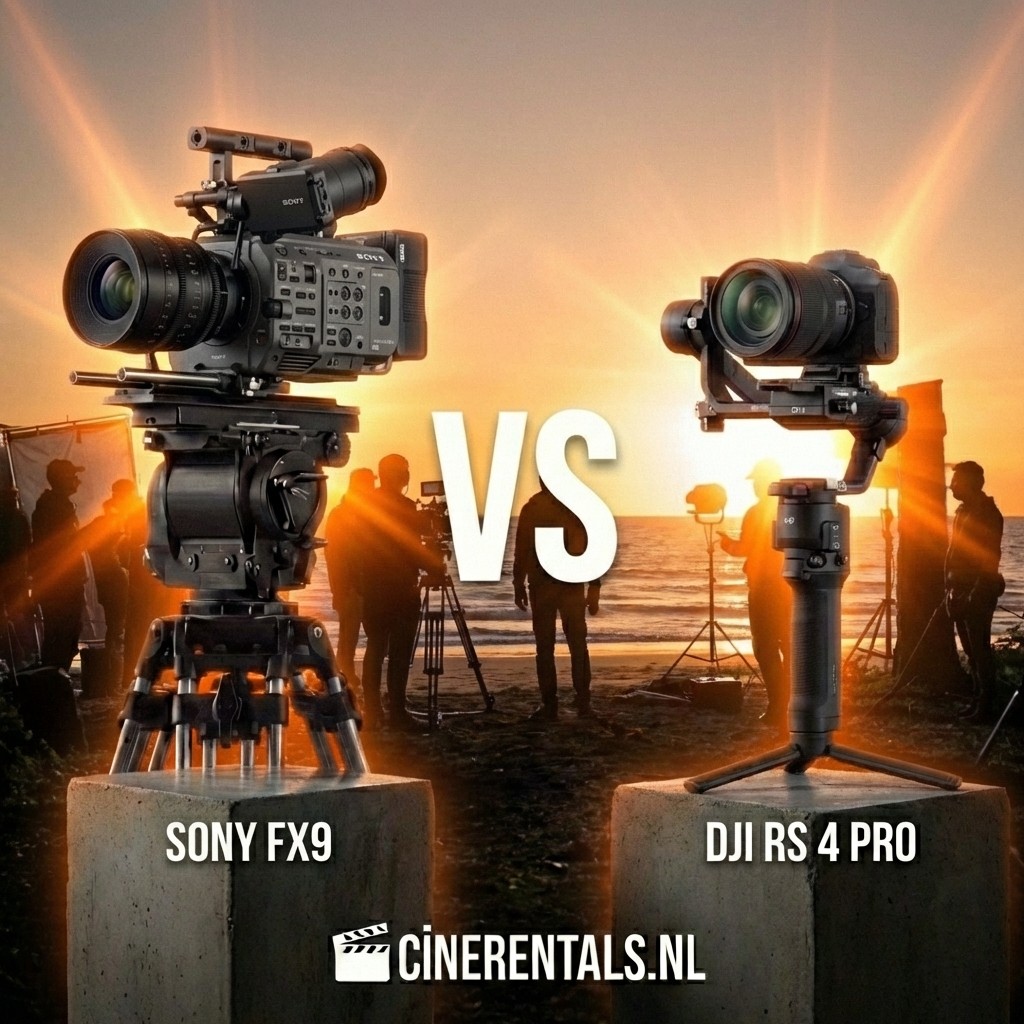
Sony's creator and cinema lineup runs from the compact ZV-E10 II up to the Sony FX9 full-frame cinema camera. The FX3 and FX6 sit at the professional midpoint — cinema-spec output in a form factor that one person can operate solo. Real-time Eye AF tracks faces and eyes automatically, S-Log3 provides wide latitude for grading, and E-mount's open licensing means over 200 compatible lenses are available.
The Sony A7 V is the current flagship mirrorless hybrid: 61 megapixels, 4K 60fps video, the latest AI-based subject recognition for tracking, and IBIS that works in combination with optical stabilisation in compatible lenses. For creators who shoot both stills and video professionally, it is one of the most capable bodies available.
DJI Drones: Adding the Third Dimension
DJI's drone range starts with the Mini 4 Pro — 249g, 4K 60fps, below EU registration thresholds — and extends to the Inspire 3 with its Zenmuse X9 full-frame sensor for cinema-grade aerial work. For most productions, the Mini 4 Pro or Mavic 3 Pro provide more than enough aerial quality.
Aerial footage has become a near-standard component of travel films, documentaries, commercials and even corporate videos. DJI's dominance in consumer and prosumer drone production means that for most creators, "DJI" and "drone" are synonymous.
DJI Gimbals: Stabilising Sony Cameras
The DJI RS4 Pro and DJI RS5 Pro are among the most popular gimbals for Sony mirrorless and cinema cameras. Both support Bluetooth control of Sony-specific settings — start/stop recording, ISO adjustment, zoom on power zoom lenses — making the combination of Sony camera and DJI gimbal one of the most efficient setups in production.
For walkaround filming, event coverage, and cinematic movement sequences, the Sony + DJI RS combination is a workflow used daily on professional productions across the industry.
DJI Ronin 4D: When DJI Replaces Sony on the Ground
The DJI Ronin 4D is a cinema camera with a built-in 4-axis gimbal, full-frame Zenmuse X9 sensor and ProRes RAW 8K recording. It competes directly with Sony FX6 and FX9 for ground-level cinema work. The key difference: the Ronin 4D has stabilisation built in, eliminating the need for a separate gimbal operator. The trade-off is weight (nearly 5kg all-in) and a more limited lens selection compared to Sony E-mount.
The Ideal Combined Workflow
The most effective setup for a complete production in 2026 is: Sony FX3 or FX6 for ground-level primary footage, DJI RS4 Pro gimbal for smooth movement sequences, and DJI Mini 4 Pro or Mavic 3 Pro for aerials. Each component does what it is best at; none attempts to cover ground it was not designed for.
Renting Sony and DJI at Cinerentals
Cinerentals stocks both Sony cameras and DJI gimbals and drones. Browse the full equipment catalogue to find the combination that fits your project.
Conclusion
Sony is the stronger choice for ground-level video production at every level of the market. DJI is indispensable for aerial footage and provides the best gimbals for stabilising Sony cameras. The two brands work together, not against each other.
Frequently Asked Questions
Can I use a DJI gimbal with a Sony camera?
Yes. The DJI RS4 Pro supports Sony E-mount cameras and enables Bluetooth control of Sony-specific functions including start/stop recording.
Is DJI Ronin 4D better than Sony FX6?
They serve similar purposes but with different priorities. Ronin 4D has built-in stabilisation. Sony FX6 has better autofocus, a wider lens ecosystem and is lighter for handheld work. The better option depends on whether stabilisation or flexibility is more important for your production.
Which is better for YouTube: Sony or DJI?
Sony is generally better for sit-down or studio YouTube content. DJI drones add aerial footage where needed. DJI Osmo Pocket 3 is a strong option for travel or active YouTube content where compactness matters.
Can I rent Sony and DJI equipment together at Cinerentals?
Yes. Cinerentals.nl rents Sony cameras and DJI gimbals and drones. Contact the team to build a combined rental package for your production.