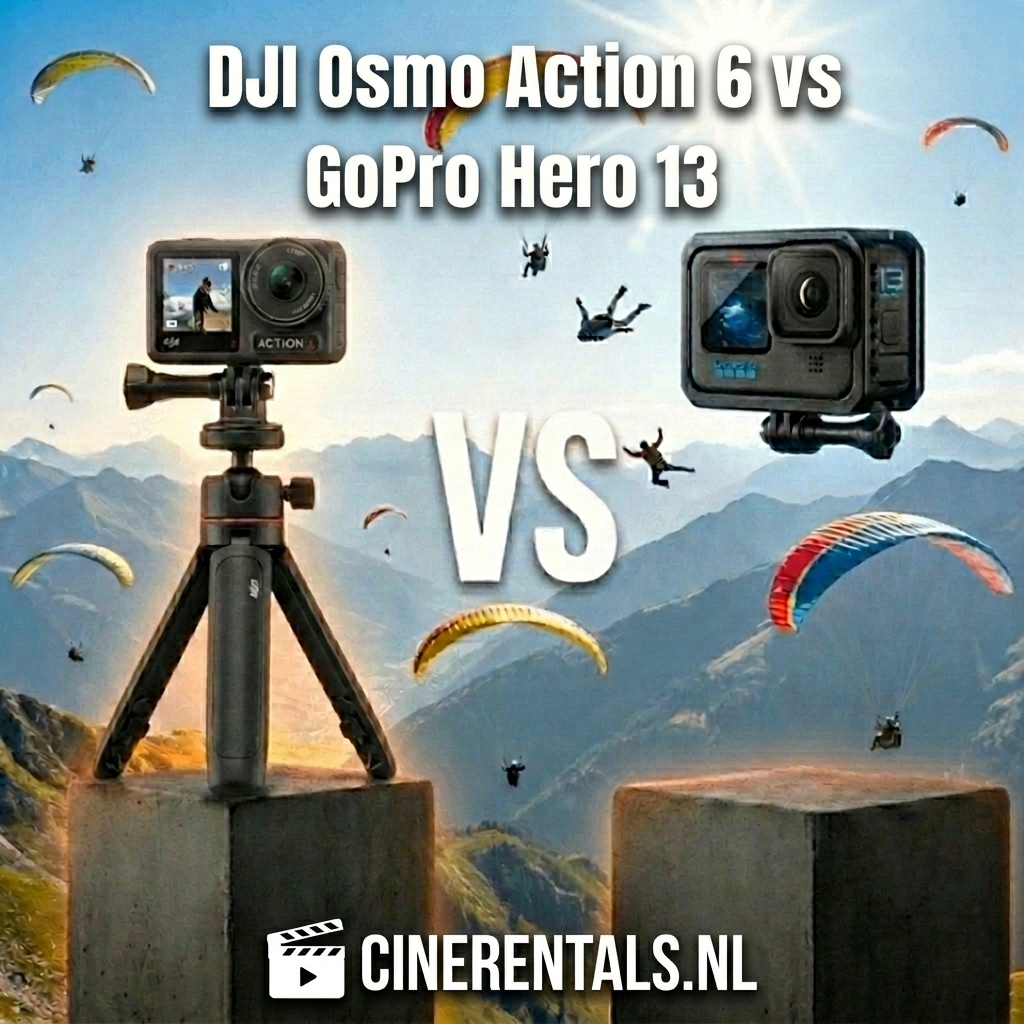
DJI and GoPro share almost total control of the action camera market — and in 2026, the competition between them is tighter than it has ever been. The DJI Osmo Action 6 wins on sensor size, low-light performance and battery life. The GoPro Hero 13 Black wins on resolution, high-frequency stabilisation and the breadth of its accessory ecosystem.
Both cameras are genuinely excellent. The right choice depends on what you shoot, where you shoot it, and which trade-offs matter to you. This guide covers every relevant difference.
DJI Osmo Action 6: The Technical Leader
The DJI Osmo Action 6 features a 1/1.3-inch sensor — meaningfully larger than the GoPro's imaging element. That single specification has downstream effects on nearly every quality metric: dynamic range, low-light noise, colour depth and overall sharpness in challenging conditions. In field tests conducted across 2025 and 2026, DJI consistently outperforms GoPro when light drops.
Battery life is another area where DJI leads. The 1950mAh cell combined with an efficient processor delivers close to double the recording time of GoPro's battery in real-world use. Less time charging and swapping batteries means more usable footage per day. For long hikes, multi-day expeditions or full-day event coverage, that adds up.
Waterproofing extends to 20 metres without a housing. GoPro Hero 13 is rated to 10 metres. For freediving, surf photography and kayaking in rough conditions, that extra depth margin can make a difference.
GoPro Hero 13 Black: Resolution and Creative Flexibility
GoPro Hero 13 Black records 5.3K at up to 60fps — the highest resolution in the action camera category and a step above DJI's standard 4K output. That extra resolution gives editors meaningful room to crop, reframe and stabilise in post without visible quality loss. For creators who finish in 4K, the 5.3K acquisition provides a safety margin.
The 8:7 aspect ratio is a feature that GoPro users love for a practical reason: you capture a wider field of view than your final output requires, then crop to whatever format you need. The same clip delivers a 16:9 landscape video, a 9:16 vertical for social, and a 1:1 square, all from a single original file.
HyperSmooth 7.0 stabilisation handles high-frequency vibration better than DJI. If your camera is mounted to a motorbike engine cover, a bicycle fork or a skateboard deck — anything generating rapid, mechanical shaking — GoPro's stabiliser keeps up where DJI's occasionally struggles.
Low-Light Performance
This is the clearest technical divide between the two cameras. DJI's larger sensor collects more photons per unit area, which means cleaner images with less digital noise when light is limited. Testing at equivalent ISO settings in indoor environments, at dusk, or under tree cover shows a measurable and visible advantage for DJI. For creators who film in suboptimal light — which describes the majority of adventure and travel scenarios — this matters.
Price and Value
DJI has historically priced the Osmo Action range below GoPro's equivalent Hero models while matching or exceeding key specifications. In 2026, the Osmo Action 6 undercuts the Hero 13 Black at retail. For creators who are buying their first action camera or adding a second unit to their kit, DJI represents better technical value per pound or euro spent.
Accessory Ecosystem
GoPro wins on accessories. Twenty years of market presence has produced hundreds of mounts, cases, handles, floats, extension poles, filters and adapters from GoPro and third parties. Whatever surface you want to attach a camera to, someone has already made a GoPro mount for it.
DJI's ecosystem is growing but younger. The core mounts are available, but niche accessories — particularly for specialist sports — are less comprehensive. If specific mounting hardware is important to your work, check DJI's compatibility list before committing.
Rent DJI and GoPro at Cinerentals
Both the GoPro Hero 13 Black and DJI action cameras are available for daily or weekly hire at Cinerentals.nl. Renting is the most practical way to test both in your actual shooting conditions before deciding which to buy.
Also worth noting: Cinerentals stocks DJI drones including the Mini 4 Pro, which pairs well with either action camera for productions that need both aerial and ground-level coverage.
Conclusion: DJI or GoPro in 2026?
DJI Osmo Action 6 is the stronger technical choice for most users in 2026: bigger sensor, better low-light, longer battery, deeper waterproofing. GoPro Hero 13 Black wins on resolution, stabilisation in high-vibration environments and the depth of its accessory ecosystem. For first-time buyers, DJI offers better value. For established GoPro users with existing mounts and accessories, the Hero 13 remains the logical upgrade.
Frequently Asked Questions
Which action camera has better stabilisation in 2026?
DJI performs better at low-frequency, flowing movement. GoPro's HyperSmooth 7.0 handles high-frequency vibration — such as engine vibration or cobblestone road judder — more effectively. Both are exceptional for their respective use cases.
Is DJI Osmo Action 6 waterproof without a case?
Yes. The DJI Osmo Action 6 is rated to 20 metres without a housing. The GoPro Hero 13 Black is rated to 10 metres without a housing. For deeper diving, both require a separate underwater housing.
Which is better for surfing: DJI or GoPro?
Both handle surf conditions well. DJI's 20m waterproofing gives it a safety advantage in wipeout scenarios. GoPro's larger accessory ecosystem means more specialist surf mounts are available. Performance in the waves is comparable between current generation models.
Where can I rent an action camera in the Netherlands?
Cinerentals.nl stocks GoPro and DJI action cameras for daily or weekly rental with delivery across the Netherlands.